How to Draw a Dolphin Step by Step
This tutorial shows how to draw a cartoon dolphin. It features 6 easy-to-follow steps with illustrated examples and simple instructions.
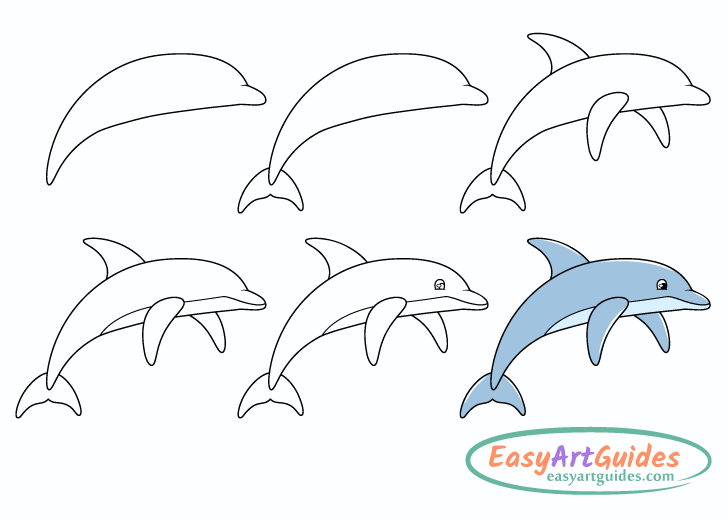
Dolphins are very interesting mammals and can be fun to draw. The dolphin in this example is drawn in a simplified and stylized way to make the tutorial beginner-friendly. The guide shows an easy-to-manage approach of building up the drawing starting from its largest parts and working down to the small details. You can see a preview of this in the image above, but there are also additional examples provided throughout the tutorial.
Be sure to start the drawing in pencil and make light lines, as you will need to erase a part of the body’s outline when adding one of the flippers. Light lines can also make it easier to correct any potential mistakes. You can darken them once you have all parts of the dolphin outlined (Step 5 of the guide).
Recommended Materials for This Dolphin Drawing
- HB Pencil: A regular pencil for creating the initial line drawing.
- Eraser: For cleaning up overlapping lines and correcting potential mistakes.
- Paper: White paper.
- Black Marker: For tracing over the initial lines to get cartoon-style black outlines.
- Blue Colored Pencils: For coloring the dolphin.
- Blue Water-Based Paint (alternative): An alternative coloring option.
- Markers (alternative): Another coloring option if you want brighter colors.
- Drawing Tablet & Software (alternative): A digital option that allows you to easily create black outlines and apply solid color fills.
Step 1 – Draw the Body of the Dolphin
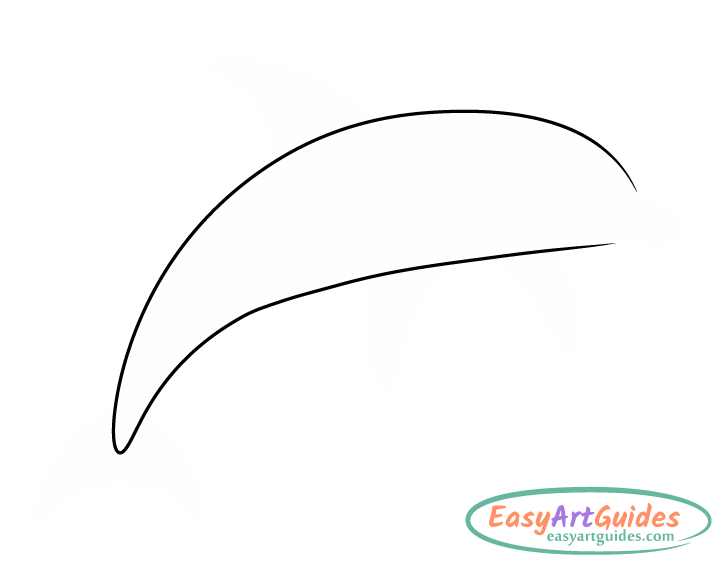
Start by drawing the outer shape of the dolphin’s body. Make it wider around the middle, slightly narrower towards the head, and much narrower around the tail. Leave the front of the body’s outline open.
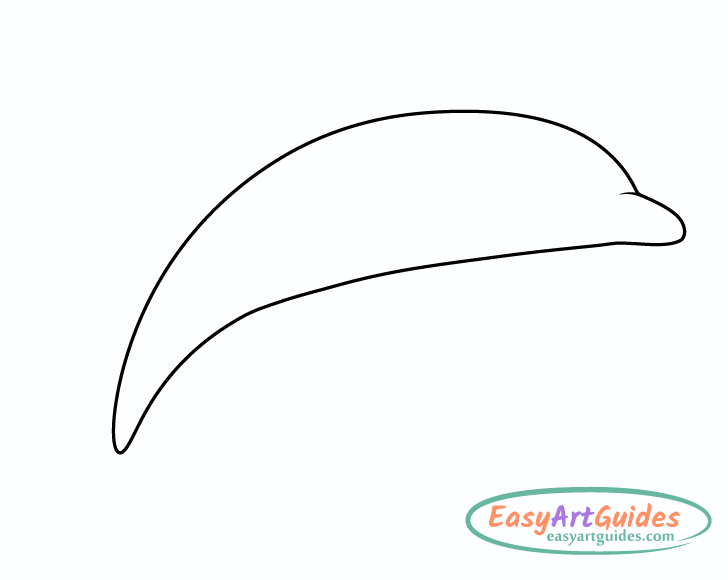
Into the opening, add the dolphin’s “snout” called the rostrum. Draw this part slightly wider at the base and make it a little narrower as it goes out (ending with a rounded tip).
Step 2 – Draw the Tail Flukes
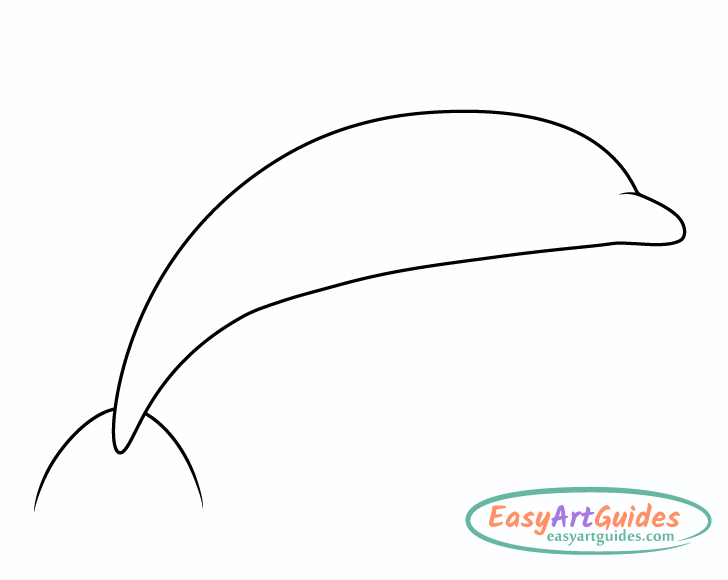
Add the dolphin’s tail flukes starting with a pair of curved lines running down from each side of the tail, beginning just a little bit past its tip.

Outline the bottom of the flukes with a pair of wavy lines. Do it in such a way as to create a split down their middle.
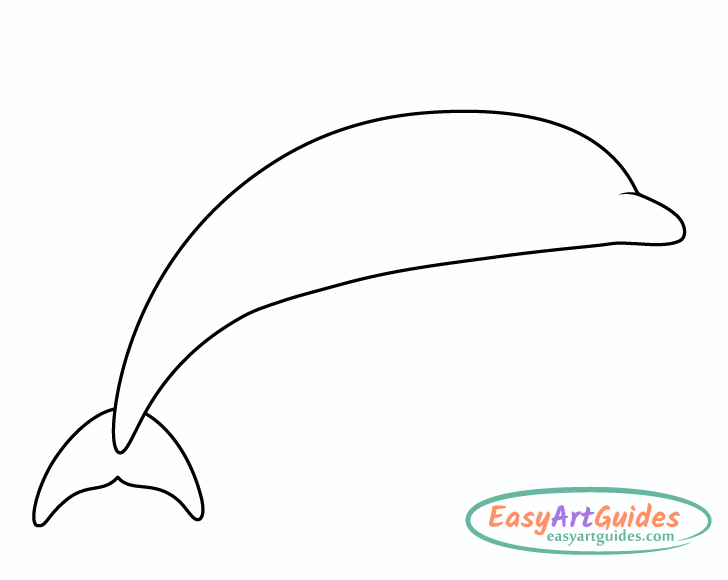
Close the gaps between the edges of the top and bottom with a pair of small curves to finish the outline of the tail flukes.
Step 3 – Draw the Fin and Flippers

At the top of the body, add the dorsal fin curving backwards with a somewhat pointy (but rounded) tip and a much wider base. Next, draw the pectoral flippers. To show that the dolphin is in 3/4 view, draw the foreground flipper (the one in the front) curving to the left and the background flipper curving to the right. Make the foreground flipper slightly wider as it runs out from the body and then narrower again, ending with a rounded tip. The base of the background flipper is hidden behind the body, so only the portion that narrows as it goes out is visible.
As mentioned at the start of the tutorial, you will need to erase part of the body’s outline when adding the foreground flipper. You can either do this before or after drawing it. Either estimate where the flipper will go and erase that part of the body’s outline, or draw the flipper and erase the part of the body that it overlaps.
Step 4 – Draw the Mouth and Define the Dolphin’s Underside

To define the dolphin’s mouth with its characteristic shape, draw a curve that runs upwards from the tip of the rostrum and then curves slightly downwards near its end.

Draw a line running from the end of the mouth and well past the flipper, eventually curving down into the bottom of the body. This line defines the dolphin’s underside area. While this is not a separate part of the body, it will be used later on when coloring.
Step 5 – Draw the Eye & Finish the Line Drawing
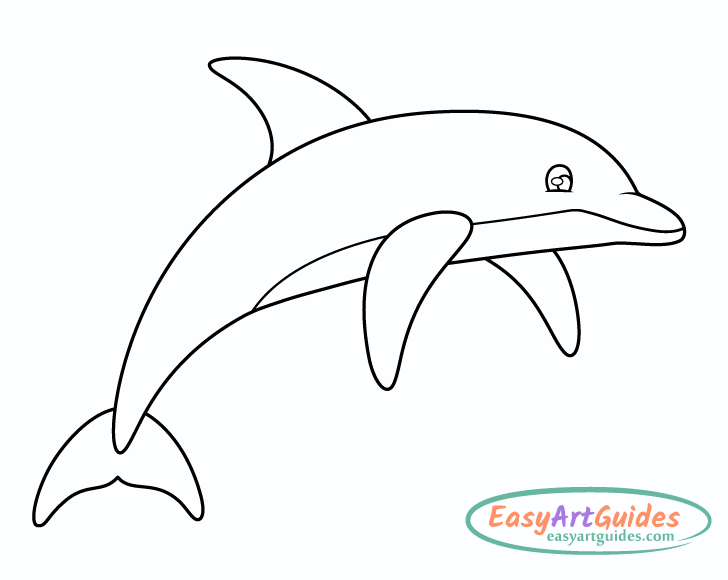
For the final step of the line drawing, add the dolphin’s eye. As this is a stylized dolphin, the eye is drawn much larger with a shape similar to those of cartoon characters.
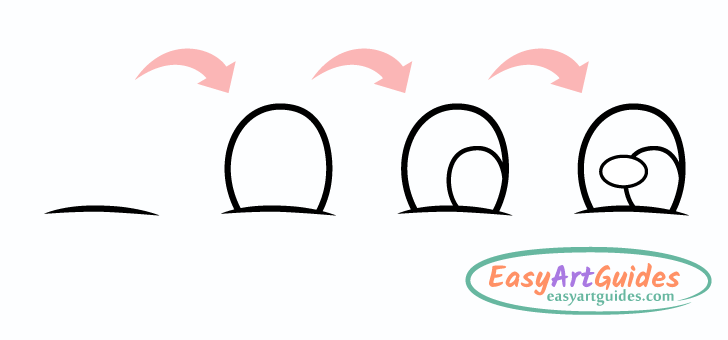
Make the bottom portion of the eye a very light curve and position it to align with the top part of the nose. Make the upper part of the outline an oval, the bottom of which is cut off by the first line.
Inside the eye, draw the pupil and make it somewhat similar in shape to the main outline. Overlapping the pupil, add an oval-shaped highlight (to show light reflecting from the eye). You can erase a little bit of the pupil’s outline where the highlight overlaps it.
To finish the line drawing, go over it with either darker pencil lines or a black marker. Also, fill in the pupil with black or dark pencil shading, but leave the highlight white.
Step 6 – Color the Dolphin
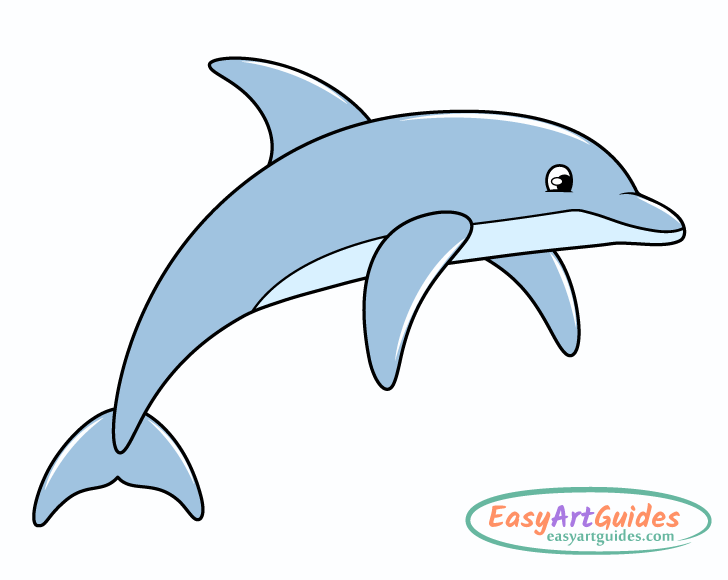
To color the dolphin, use a darker blue for the upper part of its body and a lighter blue for the underside. You can also leave a little white area inside each section of the body to show highlights. These will help make the dolphin’s skin look wet and shiny. Distribute them as follows:
- Rostrum: Upper forward area.
- Body: Upper forward area.
- Flippers: Forward-facing edges.
- Fin: Forward-facing edge.
- Tail: Upward-facing edges.
To get the lighter and darker blues, you can do it as follows:
- Blue Colored Pencil: Apply more or less pressure to a blue pencil.
- Blue Water-Based Paint: For transparent paint, mix in more or less water.
- Markers: Use separate dark blue and light blue markers.
Conclusion – Drawing a Dolphin Can be Easy & Fun
A dolphin is an interesting and fairly easy-to-draw animal, especially in the stylized cartoon manner demonstrated in this tutorial. This guide shows a structured approach to creating such a drawing, where you start with its largest parts and work down to the small details. Hopefully, you’ve found it fun and easy to follow along.
If you like simple, step-by-step tutorials like this one, you should also try some of these other drawing guides: