How to Draw a Seahorse (10 Steps)
This tutorial shows how to draw a seahorse in ten steps with a very detailed illustrated breakdowns of the animal’s various parts.
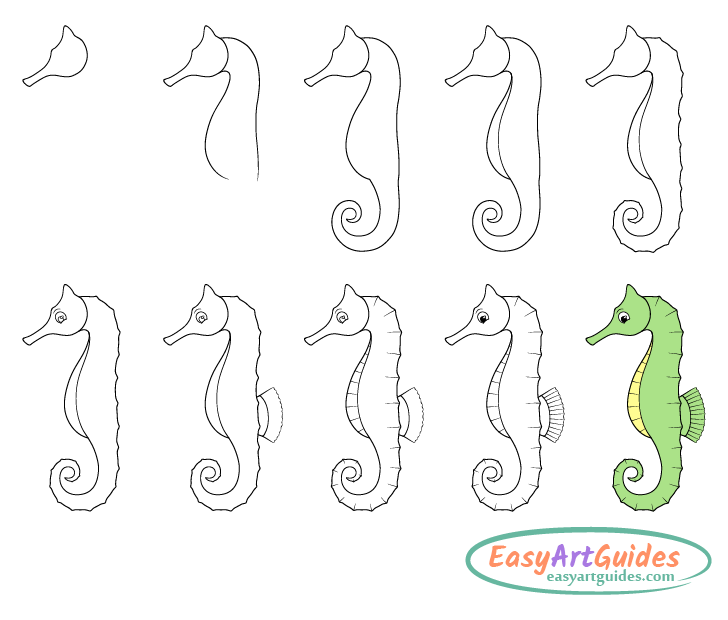
Seahorses are very distinct and interesting looking fish. The goal of this guide is showing how you can draw such a an animal in a somewhat simplified style while still keeping it’s unique look.
As mentioned, the tutorial consists of ten steps. You can see a preview of the main stages of these in the illustration above. However, there are further breakdowns shown below for the more complex parts of the drawing.
Be sure to start the tutorial in pencil as you will need to erase some ares of the drawing in a few of the steps. Try and keep your lines fairly light until you’ve defined all parts of the seahorse. You can then trace over them with a thin black marker or darken them with the pencil.
Step 1 – Draw the Head of the Seahorse

Begin by outlining the seahorse’s head. When positioning it on your drawing area be sure that you leave enough room for the rest of the seahorse’s body below it.
Give the head a thin snout, a pair of bumps near it’s middle and a coronet at the back (the really big rise/cump). Define it’s under side with a curve that goes all the way around the back and cut’s into it’s outline near the top. This will show the seahorse’s gill cover.
You can also add a few bumps to the head’s under side but make these much smaller than those along the top. Either define these in right away or draw them in after erasing parts of it’s outline.
Step 2 – Draw the Body
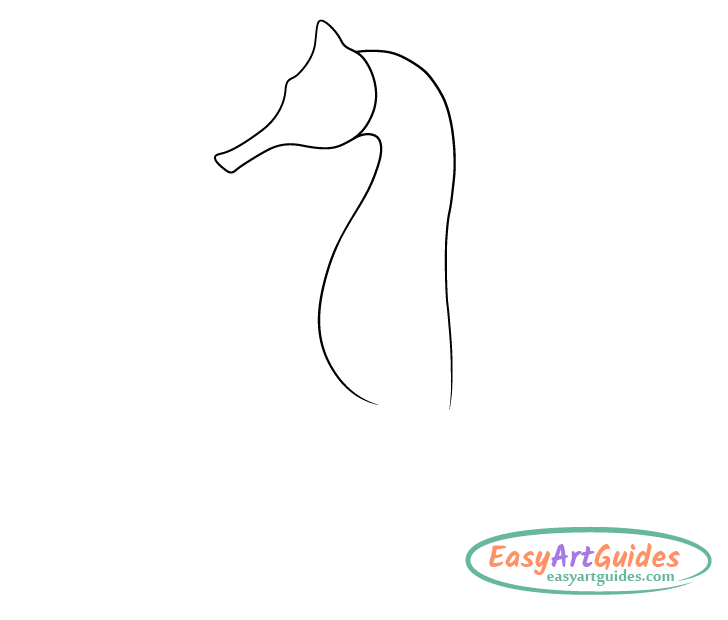
Going down from the head draw the neck and body of the seahorse. Overall these should create a question mark like shape. Make the neck slightly wider as it goes down.
Draw the outline of the body to be somewhat rounded at the front and at the back. Make it wider as it goes down from the neck and then narrower again towards the tail.
Step 3 – Draw the Tail
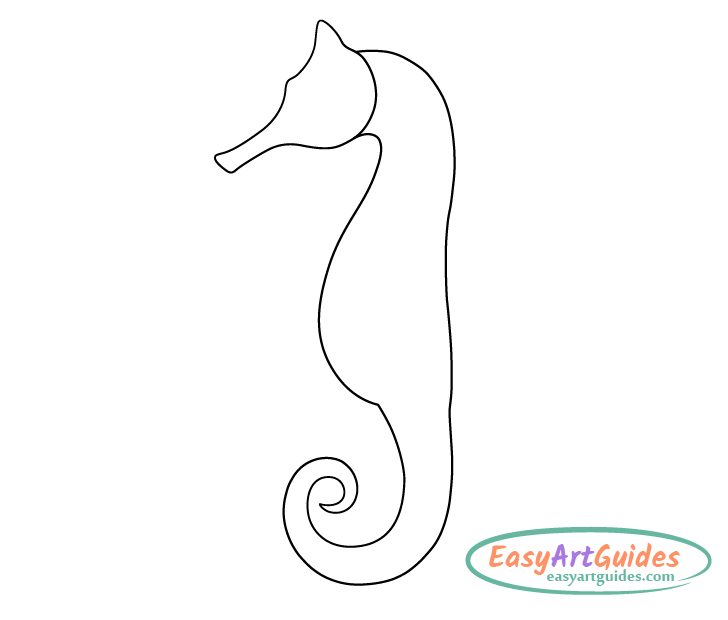
Draw the seahorse’s tail with a spiral curve and make it gradually narrower as it goes out from the body ending with a pointy tip.
Step 4 – Draw the Seahorse’s Eye
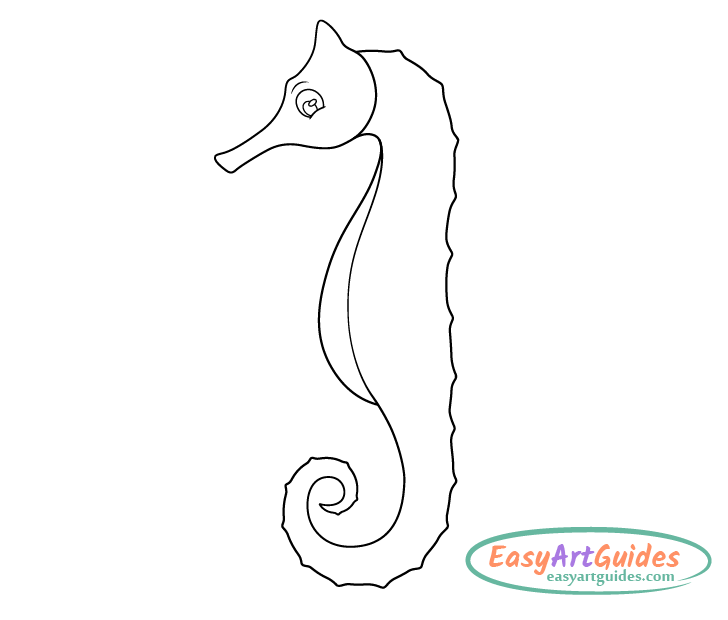
Draw the seahorse’s eye close to the pair of bumps in the middle of it’s head. Make the eye fairly round in shape (does not need to be perfectly so) with a smaller pupil inside it’s main outline. Also, draw a tiny oval shaped reflection.
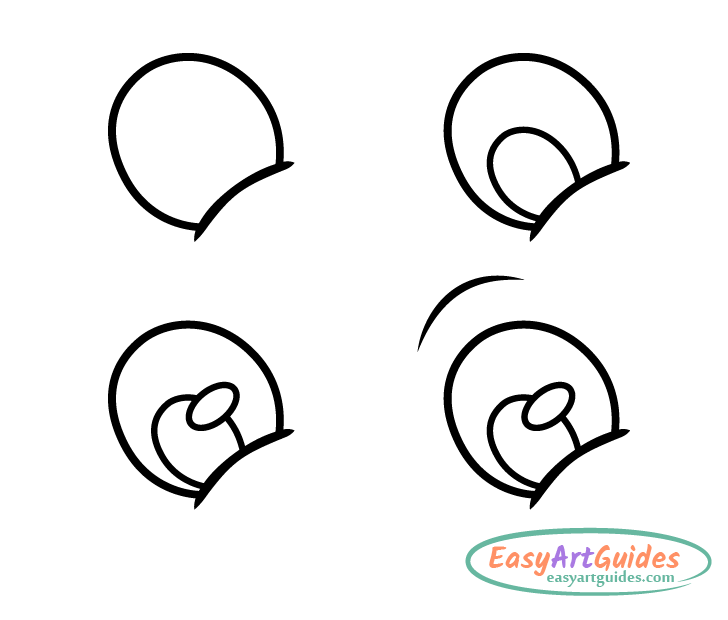
You can see a step by step example of drawing the eye above. After drawing in the reflection, erase the little bit of the pupil that it overlaps.
For drawing cartoon style eyes see:
8 Examples of How to Draw Eye Expressions
Step 5 – Draw the Fin on the Back

Draw the seahorse’s back fin along the bottom middle section of the body. Make it’s shape similar to that of a fan where it gets wider as it goes out and has a rounded end.
Step 6 – Draw the Fin on the Head

Draw the fin on the seahorse’s head shaped somewhat similar to that on it’s back. However, unlike the back fin make it wider near the top and narrower near the bottom.
Step 7 – Draw the Bumps Along the Body

Add the bumps that seahorses have on their bodies. Start with the ones running along the back and draw them going all the way from the top of the neck to the tip of the tail. Next, add some along the front of the body but make these smaller in size.

After adding the bumps, erase the part’s of the bodies outline that are now covered by them.
Step 8 – Draw the Details of the Body

For this step draw the body plates that seahorses have along their bodies. To show these, first, making a line that runs from the head, down the neck, and along the body all the way to the tip of it’s tail.

Next, draw another line running between it’s stomach area and the body. Follow the above by drawing a series of lines that run across the entire length of the seahorse. Draw them going from the front to the tips of the bumps along the back. In the area where there are bumps along the front draw the lines starting from their tips.
Step 9 – Draw the Details of the Fins

For the last set of details start by drawing the spines fanning out along the seahorse’s fins. You can define each one with a single line.

Next, draw in little curves between each of the spines.
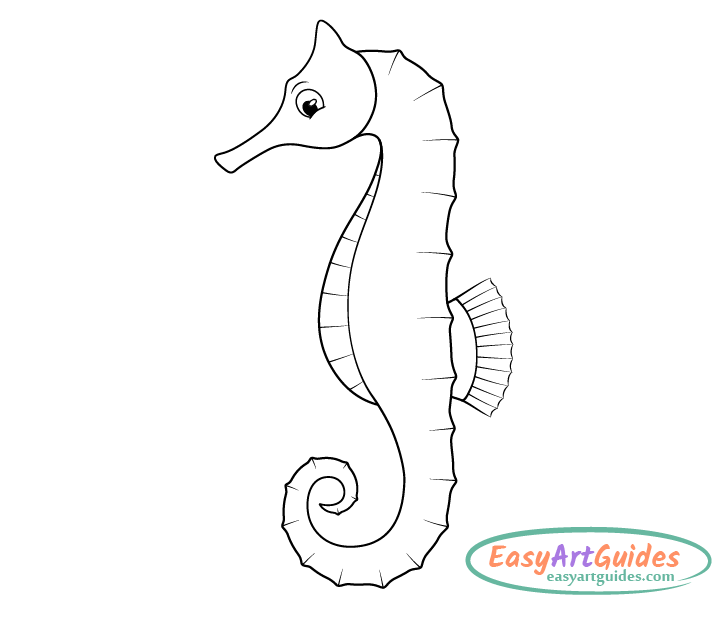
Finally, carefully erase the previous outline.

If you are having trouble seeing all of the small details here is a larger step by step of drawing each fin.
After finishing the above, trace over your drawing with darker pencil lines or a thin black marker.
Step 10 – Color the Seahorse
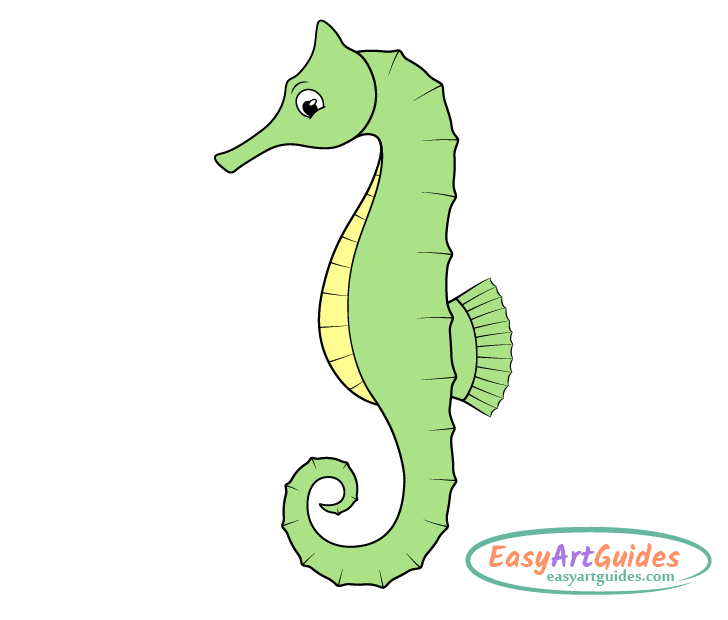
To color the seahorse do it as follows:
- Front side of the body – orange
- Back side of the body – dark orange
- Stomach, fins and eye – light yellow
- Pupil of eye – black
Leave the little reflection in the eye white.
An easy way to apply the colors is with pencil crayons but you can also use paints or markers if you wan a brighter looking drawing. For pencil crayons or makers you can create the darker orange by lightly going over the base color with a regular pencil. If going with markers be sure to wait for them to dry before doing so. Otherwise you might tear the paper.
If using paints you can simply mix in some black or brown.
Conclusion
Seahorses are very distinct and fairly unusual fish which can be quite interesting to draw. This detailed guide shows how to do so in a somewhat simplified style.
By keeping the animal’s main characteristics and leaving out some of the smaller details you can make the drawing process less complicated while still keeping the animal easily recognizable.
For more drawing guides done in a similar style, also see the following: