How to Draw a Lighter Step by Step
How to draw a metallic lighter is what is shown in this guide. It’s various parts are added in eight illustrated steps.
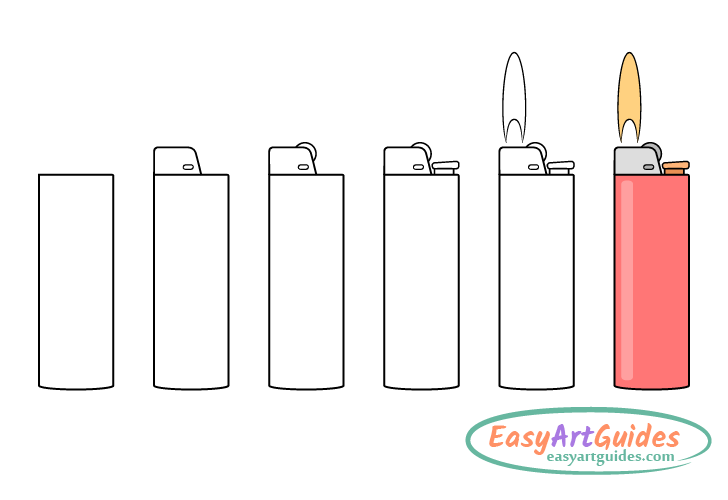
As mentioned, the drawing is of a metallic lighter with a flip cap and a flint wheel. These are often referred to as “wind proof” lighters. The example is done with a black outline and uses flat colors (colors with no gradients). Overall, the lighter is fairly detailed but still slightly simplified to make the tutorial easier for beginners.
The guide is put together in a way where it does not necessarily require any erasing. However, you should still start the drawing in pencil and use light lines to make it easier to correct potential mistakes. The lines in the example are black in all of the steps just to make them easier to see.
Once done outlining all of the lighter’s various parts, you can trace over your drawing with a thin black marker or darken your lines by pressing harder on the pencil.
Step 1 – Draw the Lighter’s Casing
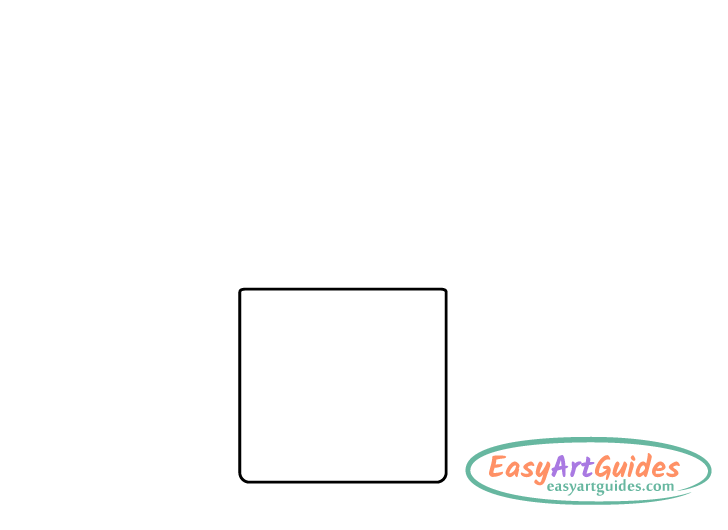
Start the drawing with the largest part of the lighter, the main body or “case”. Begin by outlining the base of this part. Make it rectangular in shape with slightly rounded corners on the bottom.
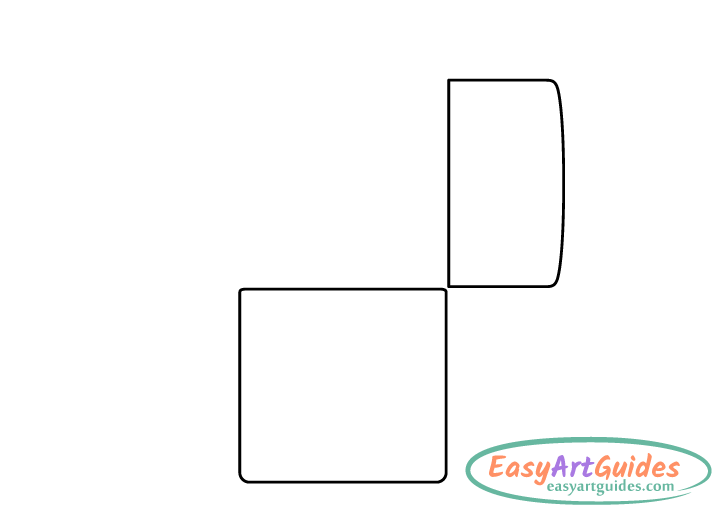
After drawing the base draw the cap swung open to the side. Make it the same width as the base but much shorter in height. Also give it a slightly rounded top as well as rounded corners on it’s upper end.
Step 2 – Draw the Wind Guard
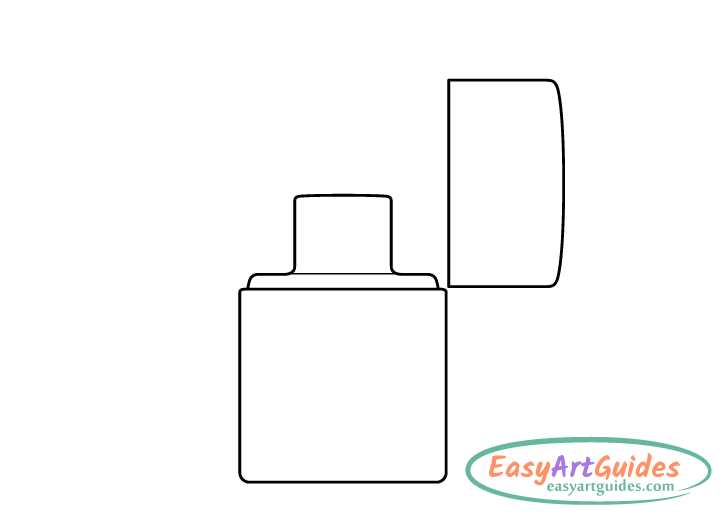
On top of the base draw the lighter’s “wing guard” or “chimney”, the part of the lighter that the flame come out of. Make it’s base slightly narrower than the case. Make it’s upper part much narrower and taller than it’s base. Also, draw all of the wind guard’s corners to be rounded and give it a very lightly rounded top as well.
Step 3 – Draw the Flame
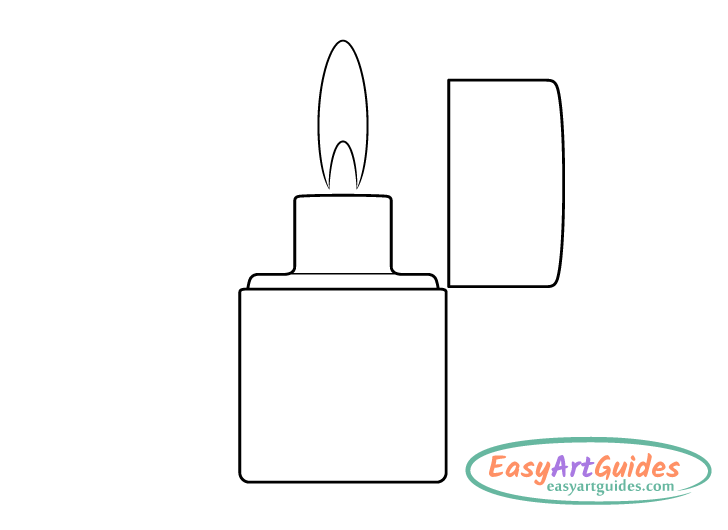
Coming out of the top of the lighter draw the flame. Make it’s shape similar to that of an oval but leave the bottom of the outline open. Next, draw what looks like much smaller half-oval going up going up from this opening to complete the flame’s shape.
Step 4 – Draw the Hinge & Cam
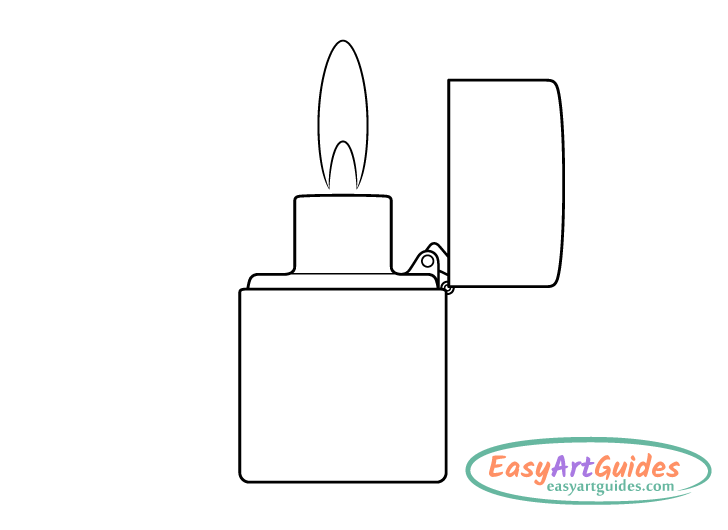
Draw the lighter’s hinge and the cam mechanism as shown in the example. The hinge when viewed from the side will appear circular in shape. The cam consist of two parts joined by a round rivet.
Step 5 – Draw the Flint Wheel
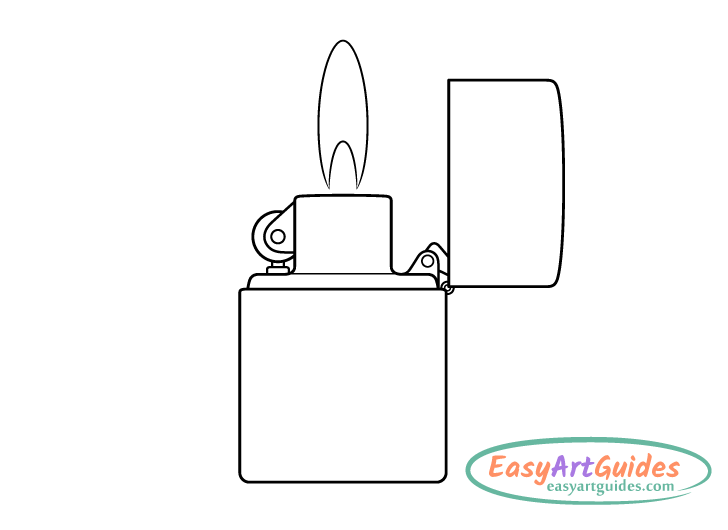
Add the flint wheel and related parts starting with the metallic housing that holds it. Draw this attached to the “chimney” area. Next, draw the wheel itself followed by the rivet that holds it in place. Be sure that when done, the wheel is centered on the rivet. As it’s only partially visible this can be a little tricky depending on your skill as an artist.
Under the flint wheel draw the flint with the wider flint tube below (the part that it comes up from).
Step 6 – Draw the “Chimney” Holes
With all of the lighter’s part’s outlined add the last set of details, the holes along it’s “chimney” area. Draw these in a diamond pattern so that the rows are positioned on an angle in relation to the part.
Make the holes near the edges of the chimney’s outline oval in shape to show that they are being viewed on an angle (as the metal is bent around this area).
After adding the chimney holes look over your drawing to make sure you are happy with how you’ve defined all of the lighter’s parts. If things look good, trace over your lines with a thin black marker or darker them with the pencil. Otherwise, make any revisions you feel are needed prior to doing so.
Step 7 – Color the Lighter
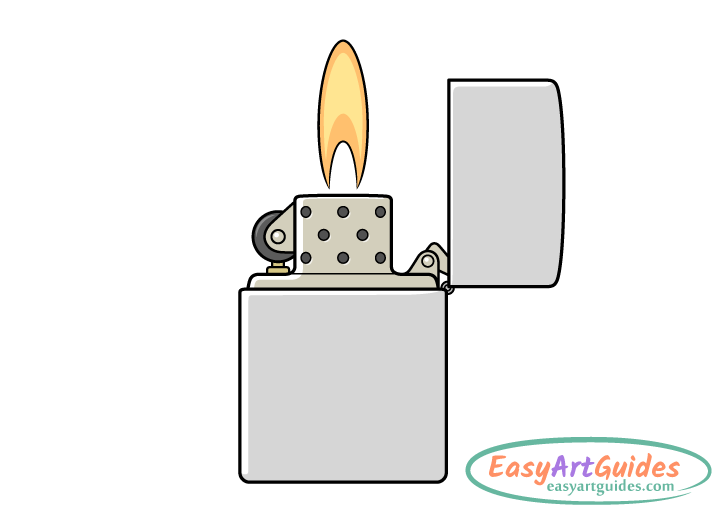
As the lighter is metallic, you will want you will want to use greys when coloring it. However, you also want to leave some white reflections along it’s different parts to give the metal a smooth and shiny look. In this case the reflections are added as though the light is coming from the lighter’s upper left.
To make it easier to see their placement the reflections are defined in blue in the example above.
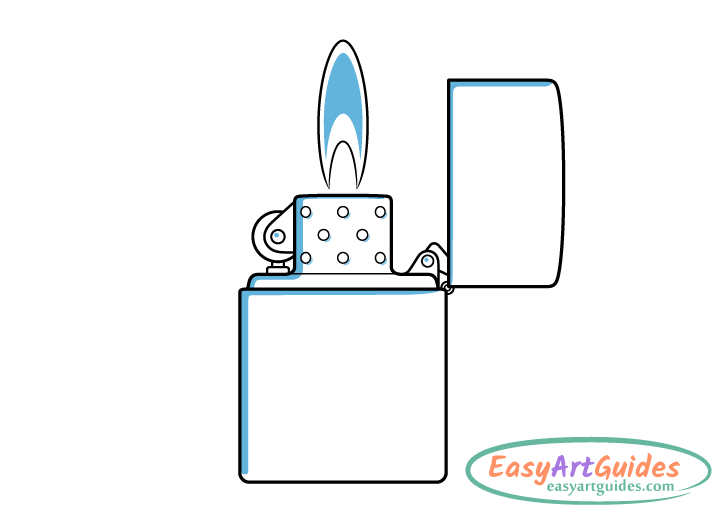
You can either outline the reflections before coloring or leave the areas white as you color. Have them in the following areas:
- Along the left side and top of the base of the case.
- Along the left side and top of the lid
- Along the left side and top of the wing guard/chimney
- On the upper left of the wheel (a thin curved strip)
- To the upper end of one side of the rivets (small circles)
- On the bottom left of each hole along the “chimney” (tiny curved strips)
The reason the chimney holes have the reflections opposite of everything else is because they are indented so they way they catch the light is different from the other parts. As these reflections are very small you can also optionally simply leave them out all together.
To color the lighter you can use a regular pencil for the grey and pencil crayons for everything else. Apply the colors as follows:
- Case and lid – light grey
- Wind guard/chimney – yellow grey
- Flint wheel – dark grey (also darken the reflection along it)
- Flint and flint tube – orange grey brown (for a brass look)
- Holes – dark grey or black
- Flame – yellow on the inside and orange around the edges
Step 8 – Add the Shadows
To finish the drawing add a few shadows along the sides of the lighter opposite the light. These will help give the drawing a more thee dimensional appearance. You can create all of them by darkening the corresponding areas using a regular pencil.
Show the shadows by adding dark strips along the bottom and right sides of the case and lid as well as along the right side of the wind guard.
Conclusion
This tutorial shows how to create a fairly detailed artwork of a “wind proof” metallic lighter. It illustrates the shapes of it’s various parts and explains how to draw them starting with the larger and more important elements. It also show how to apply some color and shading in a way that helps show that the lighter has a smooth, metallic and shiny texture.
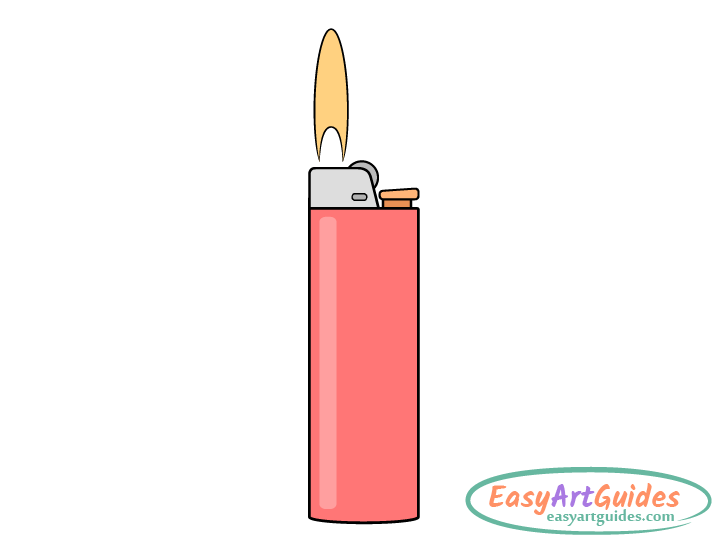
If you like these kind’s of step by step drawing guides, also be sure to try the following: